Opened today in Nadi, the Agritourism Week is a collaborative effort between the European Union, the Secretariat of the Pacific Community (SPC), the South Pacific Tourism Organisation (SPTO) and the School of Tourism and Hospitality Management at the University of the South Pacific (USP).
The Technical Centre for Agricultural and Rural Cooperation (CTA) and the Pacific Islands Private Sector Organisation (PIPSO) are also event partners, providing technical and business perspectives.
It involves nearly 100 attendees from the Pacific, Caribbean and Indian Ocean and aims to close the gap between what farmers are supplying and what the tourism operators want to buy.
« Promoting the links between agriculture and tourism can contribute to improve economic opportunities, build resilience in rural communities and enhance sustainable development », the Head of Operations for the Delegation of the European Union for the Pacific, Renato Mele, said at the event opening.
“To create jobs, you need businesses who lead innovation and change. Agriculture and tourism seem to offer the best opportunity for inclusive economic growth in the region,” Mr Mele added.
He also highlighted the commitment of the European Union to the development of the private sector, widely recognized as the engine of growth by generating jobs, contributing to public revenue and providing goods and services.
« Two European Union regional projects are already ongoing in the sectors of agriculture and tourism. These are implemented in partnership with SPC and SPTO respectively », he emphasised.
Tourism in the Pacific Island countries grew about 3.5 per cent per year between 2008 and 2012. The total value of Pacific tourism is forecast to nearly double to US$4 billion by 2019.
However, the economic benefits also come with costs. Up to 80 per cent of the food in the tourism industry is imported, partly because the hotels and airlines need reliable supplies of good quality products.
“More local content on plates and more local agrifood products on offer for visitors, tourists and the hotel industry means more income and employment opportunities for our farmers, suppliers, private sector and overall interest in the agricultural sector,” the Deputy Director of SPC’s Land Resources Division, Ken Cokanasiga, said.
“In many cases, the problems can be resolved through better communication between buyers and sellers in the agriculture and tourism sectors. The promotion of local food is also linked to showcasing healthy food choices and increasing regional trade,” Mr Cokanasiga said.
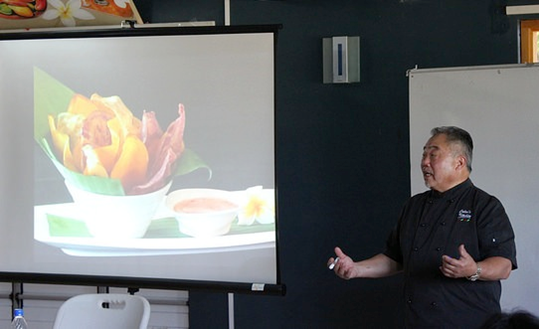
Taking place from 29 June to 3 July, Pacific Community Agritourism Week will consist of capacity building, site visits, cooking demonstrations and learning events promoting food tourism and agrifood opportunities.
To raise awareness of the event, a team of social reporters, selected from 198 applicants, will cover the sessions using Facebook, Flickr, Twitter, Youtube and other social media.
Supported by CTA (through its Agriculture, Rural Development and Youth in the Information society Project – ARDYIS) and SPC, the on-site reporters are Tom-Vaitolo Vaha of Niue, Kuata Taumaheke of Tuvalu, Carole Cholai of Papua New Guinea, Deffnie Thompson and Lopez Adams of Vanuatu, Avneel Chand of Fiji, led and trained by CTA’s Nawsheen Hosenally.
While the objective of the social media reporting is to raise awareness of the event, engage on-site participants and reach out to a wider audience remotely, another goal for CTA and SPC is to build the capacity of social reporting in the Pacific region.
A communique is expected to contain a call to action around the types of activities that could be undertaken collaboratively, and supported, to address existing challenges and take advantage of the opportunities that exist between the agriculture and tourism sectors.
Case studies and videos will be among the learning tools produced for wide dissemination to policy makers, chefs, farmers and other stakeholders, including via portals such as SPC’s Pacific Agriculture and Forestry Policy Network – (PAFPNet).
More event information is available at: www.spc.int/pafpnet/newsroom/pacific-agritourism-week.
 Le Blog de Louis Agbokou